
Police fired tear gas and rubber bullets as clashes broke out in Madrid and Barcelona on Wednesday following large-scale protests across Spain over rising housing costs and declining purchasing power. The demonstrations coincided with the country’s first nationwide 24-hour general strike since 2012, weeks before an early general election scheduled for November 29.
Authorities estimated that around 120,000 people marched in Madrid, while more than 50,000 gathered in Barcelona. Thousands of others participated in demonstrations across the country, demanding affordable housing and action against rising rents.
The protests were followed by clashes involving groups of hooded and masked demonstrators who allegedly threw projectiles at police and set fire to objects on the streets, according to AFP journalists.
Police use tear gas as clashes erupt in Madrid, Barcelona
In Barcelona, video footage showed rubbish containers, bicycles and potted plants burning on roads as police vehicles moved through the affected areas.
Police used tear gas and rubber bullet launchers to disperse groups of protesters and arrested 18 people in the city.
The demonstrations followed weeks of growing public anger over housing affordability, with protesters accusing authorities of failing to address rising rents and difficulties in purchasing homes.
The latest wave of protests was also linked to the eviction of an 87-year-old woman from her Madrid home in September.
Protesters demand affordable housing
Despite heavy rainfall, thousands of demonstrators gathered in Madrid carrying placards shaped like houses and chanting slogans such as “we have no home”.
“People work a lot and it isn’t enough to pay the rent, to pay for a house,” Paula Diaz, a 25-year-old theatre technician who lives with her parents, told AFP.
“I hope a government that benefits us comes to power, especially the working class,” she added, referring to the November 29 election.
In Barcelona, authorities estimated that around 55,000 people marched along Passeig de Gracia, a major commercial thoroughfare known for its luxury stores.
Maria Pinana, who participated in the demonstration, said housing should not be treated like an ordinary commodity.
“The law of supply and demand does not apply to housing,” she told AFP.
“The price of rents should be regulated,” said the 34-year-old microbiologist, who shares a flat with friends where parts of the ceiling have collapsed.
Nationwide strike disrupts transport and workplaces
The main trade unions, UGT and CCOO, called the 24-hour strike over housing affordability and purchasing power. Demonstrators and workers also blocked roads in Madrid and other parts of the country, while picketing took place at several workplaces.
Public transport services were disrupted, particularly around Barcelona, despite minimum service requirements being imposed for commuter trains, metro services and buses.
Madrid’s metro reported that 93 per cent
of its trains operated during the early morning hours, although passenger numbers were around half their usual level.
UGT leader Pepe Alvarez described participation in the strike as “massive” and said some regions had witnessed a complete stoppage. He called the action a major success.
However, the union acknowledged that participation varied across sectors and regions, with stronger mobilisation in automobile manufacturing, petrochemicals, meat processing and coastal areas.
Business groups dispute strike’s impact
The CEOE, which represents Spanish business leaders, described the strike as a “failure”, arguing that economic activity continued normally across most sectors.
The organisation also said electricity demand had fallen by around 5 per cent, significantly less than during previous strikes.
The contrasting assessments highlighted disagreements over the scale and impact of the nationwide industrial action.
Housing crisis becomes key election issue
The demonstrations have added to political pressure on Prime Minister Pedro Sanchez’s government ahead of the November 29 general election.
Sanchez called the early election after his minority government failed to secure parliamentary approval for a package of housing measures proposed in response to public protests. The election was originally scheduled for 2027.
Housing affordability has emerged as a major issue for voters, with tenants and housing campaigners demanding stronger regulation of rents and greater access to affordable homes.
Valeria Racu, spokesperson for the Madrid Tenants’ Union, which has been at the forefront of the protests, said the movement wanted to challenge the treatment of housing as a business.
“A new cycle is beginning with trade unionism and conflict at its centre. This day of strikes has been a resounding success,” she said.
Isabel Iglesias, a 27-year-old nurse living in Madrid, said housing costs were among her biggest financial concerns. She pays 1,000 euros in monthly rent with her partner despite earning 1,700 euros a month.
Iglesias said Sanchez “could have done much more” to address the housing crisis and urged the next government “to listen to everyone and get their act together”.
(With inputs from AFP)
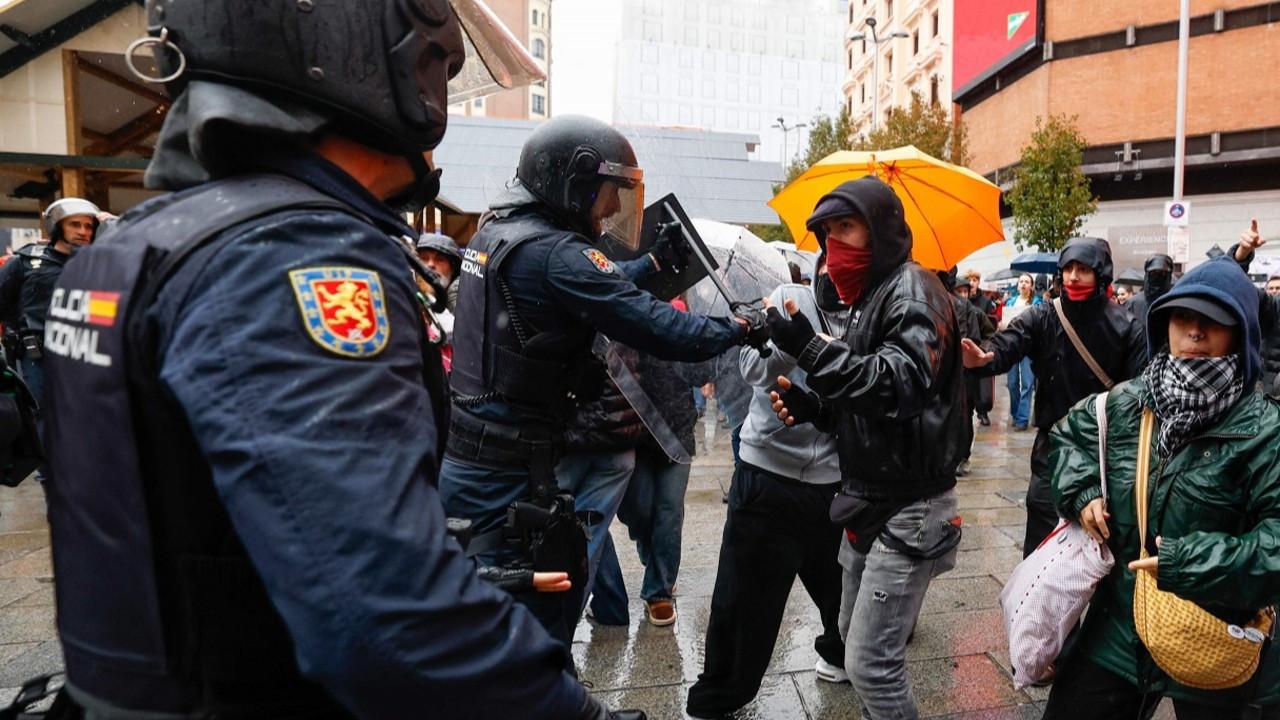
Spain housing protests turn violent as police fire tear gas and rubber bullets
